

Queen Elizabeth National Park is one of the oldest national parks in Uganda and it was formed along with Murchison Falls National Park in 1952. It contains over 95 species of mammals and over 600 species of birds making it the second highest national park with birds in Africa and the six’s (6th) highest of any other park worldwide and it has been enabled by its diverse habitats and species. The park covers 1978km2 and it is located in the far west of Uganda lying on the Africa’s Western Rift Valley.
Initially in 1925, it was gazetted as Lake George and Lake Edward Wildlife Reserve until 1952 when it was upgraded to national park hence it being called Kazinga National Park. Later in 1954, it was renamed to Queen Elizabeth National Park to commemorate a visit by Queen Elizabeth II of Great Britain.
The range of landscape of Queen Elizabeth National Park provides a diverse habitat varying from semi-deciduous forest of Maramagambo, savannah grassland, crater lakes and swamps bordering Lake George and Lake Edward.
The famous Kazinga Channel connects and leads the water flow from Lake George to Lake Edward and it divides the park into two parts. The boat cruise here is superb and an experience is worthy visiting so that you can witness yourself. It will provide you the opportunity to see various Hippos, crocodiles, Buffaloes, Elephants, antelopes on the shores of this channel and above all the ambiance is so interesting.
The northern part of the Kazinga Channel is hometo various animals and bird species including Elephants, Buffaloes, Lions, Uganda Kobs, Water bucks, Bush bucks, warthogs, Mangoose, and Leopards can be luckily seen. Then in the north east part of Lake Edward is composed of crater and salt lakes which makes it an extra ordinary area to visit. The lakes were formed by volcanic activities some years back between 8000 to 10000 years back.
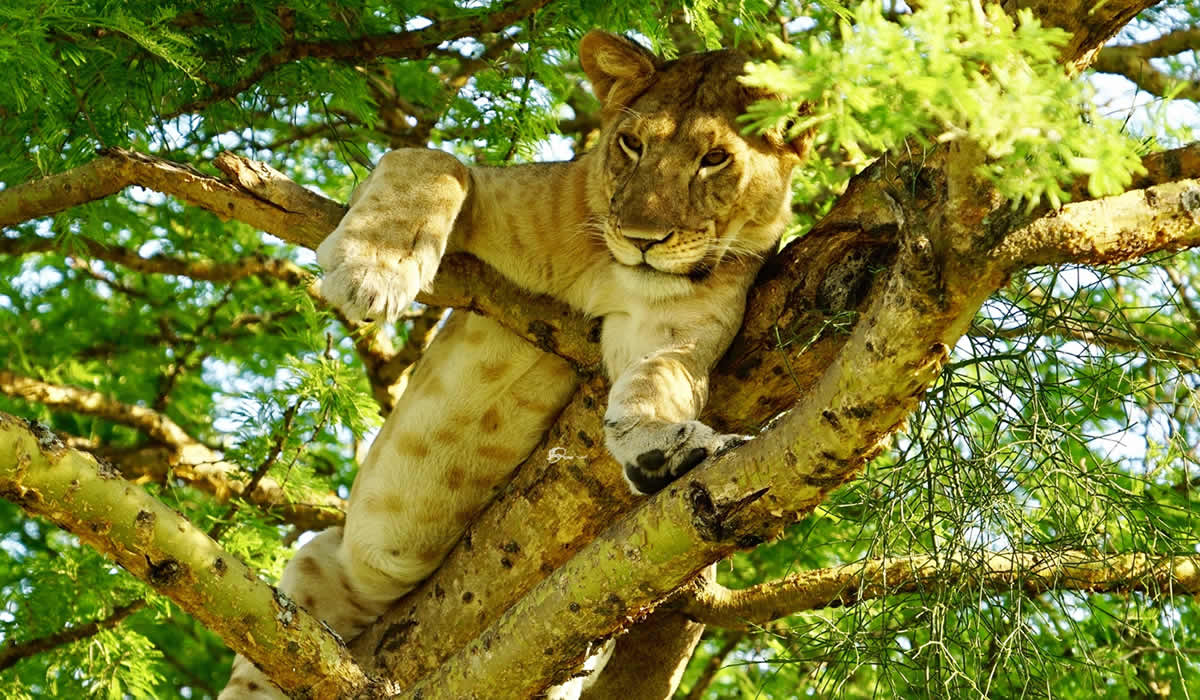
The Southern part of the park is more populated with games but the Maramagambo Forest is home to a variety of primates and actually it harbors 10 species of primates such as Chimpanzees, White and black colobus monkey, blue and red-tailed monkeys among other species. The Ishaha Sector of the park in the southern part is renowned of the tree climbing Lions and they can only be found in Queen Elizabeth National Park in Ishaha sector and Lake Manyara National Park in Tanzania.
CLIMATE
Queen Elizabeth National Park is composed of warm climate. The days are warm and the nights are cold. The average temperatures range from 180C to 280C and the temperatures are the same throughout the year. In the day times, the temperatures tend to rise to 280C and in the nights, the temperatures fall up to 180C.
Dry Season / High season: This is the best time to visit Queen Elizabeth National Park and it runs from the month of June to September and from End of December to February. However, there can be drizzles at any time.
Rainy Season / Low Season: These run through the month of March to May and also October to Mid-December, so roads become muddy and Safari Landcruiser is recommended.
ACCESS / HOW TO GET THERE
BY ROAD TRANSPORT
From Kampala to Mityana Road, Mityana to Mubende road up to Fort portal then you can connect to Kasese road up to crater gate is one way you can access Queen Elizabeth National Park and it takes 371 km to reach the Park.
Queen Elizabeth National Park can be accessed via Kampala to Masaka road joined by Masaka to Mbarara Road and then Mbarara to Kasaese Road through Bushenyi and Ntungamo district then you will reach to the park through Katunguru Gate or to your chosen accommodation. It takes 422km to reach Queen Elizabeth National Park from Kampala.
The park can also be accessed from Bwindi Impenetrable National Park through Ishasha sector.
BY AIR TRANSPORT
One can fly using the domestic flight from Entebbe International Airport to Mweya Airstrip and the driver guide will pick you from the airstrip to the lodge or any other chosen accommodation.
Also, one can fly from any other airstrip to Mweya airstrip for example Kihihi airstrip to Mweya airstrip or pakuba airstrip in Murchison falls National Park to Mweya airstrip etc.
Lastly, clients can fly from Entebbe International airport to Kasese airstrip and then you will be picked by our driver guide, who will then take you to Queen Elizabeth National Park.
TOURISM / TOURIST ACTIVITIES IN QUEEN ELIZABETH NATIONAL PARK
-
Game drive at Kasenyi Plains, Queens Mile and Ishasha Sector
The game drives are commonly done atKasenyi plains, Mweya Savannah or north of Kazinga Channel and Ishasha sector for the perfect game viewing experience, it offers a guaranteed sighting of Buffaloes, Antelopes and Elephants. The ranger guides can help you look for the predators like Lions, Leopards and Hyenas, it is better to do Lion experience activity and there is high chance of spotting the Lions because the operators will track and spot the lions easily. In the other hand, Ishasha sector in the southern sector of the park provides chances of spotting Bufalloes, Elephants, and antelopes, warthogs and Baboons. Above all Ishasha sector is the home of tree climbing Lions and by the help of the ranger guide it will be spotted for you resting on the shady tree branches which makes it easy for them to spot the preys.
-
Boat cruise / trip or Launch cruise at Kazinga Channel
In Queen Elizabeth National Park, the boat cruise is done on Kazinga Channel which leads water flow from the west in Lake George to Lake Edward. The channel is rich of aquatic life and Terrestrial animals, the aquatic animals spotted include Hippopotamus and Crocodiles with water birds like African Skimmer, Goliath Heron, Pied Kingfishers among others birds and Terrestrials animals are always on the shores of the channel resting and taking water, so you can spot Elephants, Buffaloes, Water bucks, Bush Bucks and warthogs and it makes it interesting to cruise on the channel. The boat cruise takes a maximum of two hours and on this journey, one can spot over 60 bird species during the boat trip on the Kazinga Channel. We have boats which carry over 40 passengers by different boat operators, the boat guarantees a seat with perfect view and the ranger guides will tell the different stories of wildlife.
The boat cruise Start at three different intervals and that is at 9:00am with a minimum of 4 pax, 2:00pm and 4:00pm. The afternoon and sunset cruises start with any number and has no limitations and they are most preferred cruises at Kazinga Channel in Queen Elizabeth National Park.
-
Chimpanzee tracking at Kyambura Gorge
The Canyon was formed as a result of Kyambura river which runs underneath of the Kichwamba escarpment and it runs for 100 meters. it is a narrow valley between hills or mountains, typically with steep rocky walls and a stream running through it.
The George is also known as a valley of Apes and it is located on the north eastern part of Queen Elizabeth National Park which is 30km away from Uganda Wildlife Authority Headquarters.
Kyambura Gorge is a home to the Habituated Chimpanzees in Queen Elizabeth National Park and these are closest creatures to Human beings and there are also other primates like the white and black colobus monkey, blue and red-tailed monkey, baboons among other species, they can only be seen during Chimpanzee tracking at Kyambura Gorge.
In Kyambura Gorge, the chimpanzees can be tracked both in morning and afternoon depending on Chimpanzee permit availability as they are served based on first come first serve basis and the chance of seeing the chimpanzees stands at 99%.
-
Guided Nature walk / Forest walk
Nature walks can be done in areas of Maramagambo Forest and Mweya Peninsular. During the walk you will spot different animal and bird species among which include Elephants, Bufalloes, Antelopes, Mongoose etc. And you will also visit the Bat Cave at Maramagambo forest which is most interesting and also at Kyambura gorge which gives chance to spot Chimpanzees and other primates during your nature walk. The ranger guide will also explain to you the different tree species with their importance.
-
Bird watching / Birding
The park has over 600 bird species and this makes it an outstanding place for bird watching in Uganda, East Africa and worldwide. It can be done in the areas of Kazinga channel where the water species can be seen, Kasenyi area, Mweya Peninsula, Maramagambo Forest, Ishasha sector, Lake Kikorongo, Katunguri bridge and Katwe area. You can spot African Skimmer, Flamingoes, Goliath Heron, Hadada Ibis, Pied Kingfisher, Fish Eagle and other many bird species. You will be provided with professional birding guide and when you arrive at the park, you will be joined by the experienced bird watching ranger guide to protect you during the walk.
ACCOMMODATIONS / WHERE TO STAY
HIGH END LODGES / LUXURY FACILITIES AT QUEEN ELIZABETH NATIONAL PARK
- Mweya Safari Lodge
- Ishasha Wilderness Camp
- Kyambura Game Lodge
- Kasenyi Safari Camp
- Kyambura Gorge Lodge
MID-RANGE FACILITIES AT QUEEN ELIZABETH NATIONAL PARK
- Buffalo Safari Lodge
- Enganzi Game Lodge
- Jacana Safari Lodge
- Park View Safari Lodge
- Hippo Safari Lodge
- Kyangabi Crater Resort
- Katara Lodge
- Ihamba Lakeside Safari Lodge
- Marafiki Safari Lodge
- Elephant Plains Lodge
BASIC / BUDGET LODGE FACILITIES IN QUEEN ELIZABETH NATIONAL PARK
- Bush Lodge
- Simba Safari Camp
- Elephant Hub Lodge
- Pumba Safari Lodge
- Kyambura Tented Camp
- Tembo Safari Lodge
- Engiri Game Lodge and Campsite